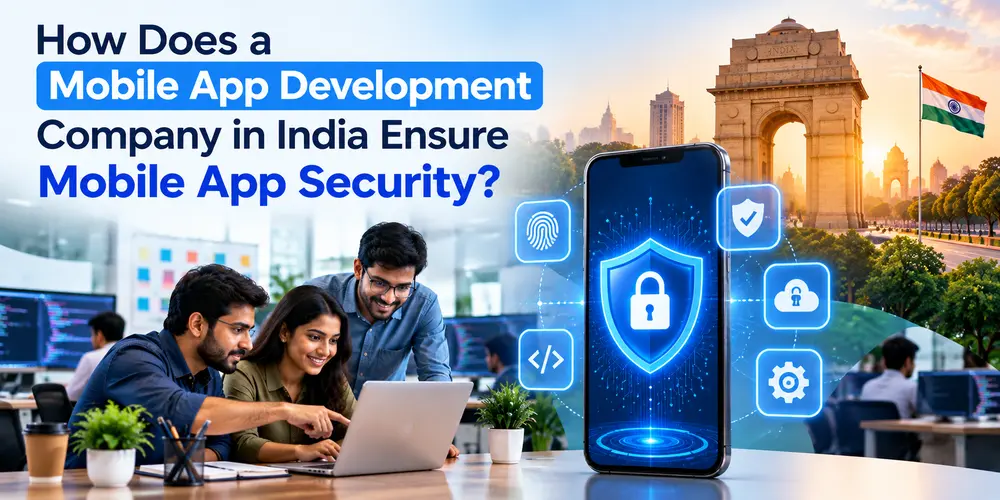
Date: 25 Sep, 2026
In today’s digital-first world, mobile apps do everything, from banking details to private health records. So, security is a must, not just “maybe”. A dependable Mobile App Development Company in India knows that even one tiny weakness can mess up user trust, hurt a brand’s image. and also break business continuity. That’s why the best teams, often working alongside a Web Development Company in India, put a multi-layered security setup in place that touches every step of the app journey planning, coding, deployment, and maintenance. So basically, let’s see how these companies end up building apps that are secure, reliable, and honestly future-ready, without cutting corners.
Real security isn’t an afterthought; it’s baked into the architecture from the start. Before anyone writes code, teams run a risk assessment first, to catch vulnerabilities tied to the app’s specific industry, like fintech, healthcare, e-commerce, or logistics. This usually includes things like:
When you do this early, the security requirements actually shape the technical plan, not get “fixed” later in a rush.
One of the main ways developers keep apps safe is by using secure coding standards. This covers input validation so things like SQL injection, and cross-site scripting (XSS) can’t slide in quietly. They also handle errors properly, so the app doesn’t leak sensitive system details. And yeah, regular code reviews matter, because finding issues early is cheaper and faster. Plus, they never hardcode sensitive stuff like API keys or passwords in the source code; instead, they use secure vaults, or environment variables.
Weak login flows are one of the most common doors attackers use. To reduce that risk, teams add multi-factor authentication (MFA), biometric sign-in like fingerprint or face recognition, OAuth 2.0 plus token-based authentication (JWT), and role-based access control (RBAC). That means different user types only see what they’re supposed to. The overall idea is simple, verified users get access to sensitive areas while the wrong ones hit a wall.
Most mobile apps rely on APIs to talk to backend servers, so API security is huge. Development teams protect APIs with rate limiting API gateways that monitor and filter incoming requests, strict auth tokens for every API call, and ongoing API vulnerability scanning. Even if everything else looks strong, an unsecured API can become the weakest link, so it’s never skipped.
Security testing isn’t a one-time “done” thing. It keeps running across the whole lifecycle. This typically includes penetration testing to imitate real-world attacks, static and dynamic code analysis (SAST/DAST), vulnerability scanning tools, and third-party security audits, especially for high-risk apps. Also , this is where companies sometimes realize how valuable an integrated digital strategy can be. Just like how a Digital Marketing Company in India helps you pull in the right audience in a credible way, security testing helps ensure that once users arrive, their data stays protected. Marketing brings people in, security helps them feel safe enough to stick around.
The app interface might look clean, but if the backend is messy, the whole system is in trouble. Developers make sure firewalls and intrusion detection systems are turned on, cloud servers (AWS, Azure, Google Cloud) have strict access controls, backups are encrypted and stored properly, and server software stays updated so known issues get patched. And companies going for a full digital setup often also work with a Website Design Company in India, so app and web platforms stay secure and professional, at the same time.
Finally, developers help users protect themselves too. They add session timeouts, login alerts for new devices, and permission prompts that explain clearly why the app needs camera, location, or contacts. Sometimes those security prompts are shaped with help from a Graphic Design Company in Delhi, so the alerts feel intuitive, not like confusing pop-ups people tap away without reading.
Mobile app security isn’t one single feature. It’s a continuous, layered commitment across planning, coding, testing, and long-term maintenance. A solid Mobile App Development Company in India treats security like part of the development mindset, not some checkbox at the end. That way your app can protect user data while still delivering a smooth experience. If you want a security-first, end-to-end partner, scmsurgetech.com offers mobile app solutions built with strong protection at every layer.
1. Why is mobile app security important for businesses?
Because mobile app security helps guard sensitive user data, it prevents possible financial loss and keeps customer trust and also supports brand reputation later down the line, even when people mostly notice the app features not the protection.
2. What is the most common mobile app security threat?
Usually it comes down to insecure data storage, weak authentication, and unprotected APIs, attackers sort of circle the same gaps again and again like it’s routine.
3. How often should a mobile app be security tested?
Ideally security testing should happen while building, before every major release, and then periodically after launch, not just once and then “done”.
4. Does app store approval guarantee security?
No, not really. App store approval mostly checks for policy compliance, but developers still have to do the whole security thing themselves, on their own side as well.
5. What role does encryption play in app security?
Encryption helps keep data safe both while its stored and while it is traveling, so it turns into effectively unreadable information for unauthorized people, even if it gets intercepted somehow.
6. Can a small business really afford strong app security?
Yes. A lot of good practices like secure coding and HTTPS are pretty cost-effective, and they can be stitched right into the development workflow, without huge extra spending.
7. How long does it take to build a secure mobile app?
That depends on the app complexity, but when security is planned early it usually adds only a small bit of time, compared to fixing things after the launch.
8. Should security be considered for both Android and iOS apps?
Yes, absolutely. Android and iOS are different in their weak points, so the security plan should be adjusted for each operating system, separately and more carefully.
23 Sep, 2026

16 Sep, 2026

08 Sep, 2026

02 Sep, 2026

24 Aug, 2026

20 Aug, 2026

19 Aug, 2026
11 Aug, 2026



 Website Design
 Web Development
 Graphic Design
 Digital Marketing
 Mobile App Development